Single Session Therapy (SST)
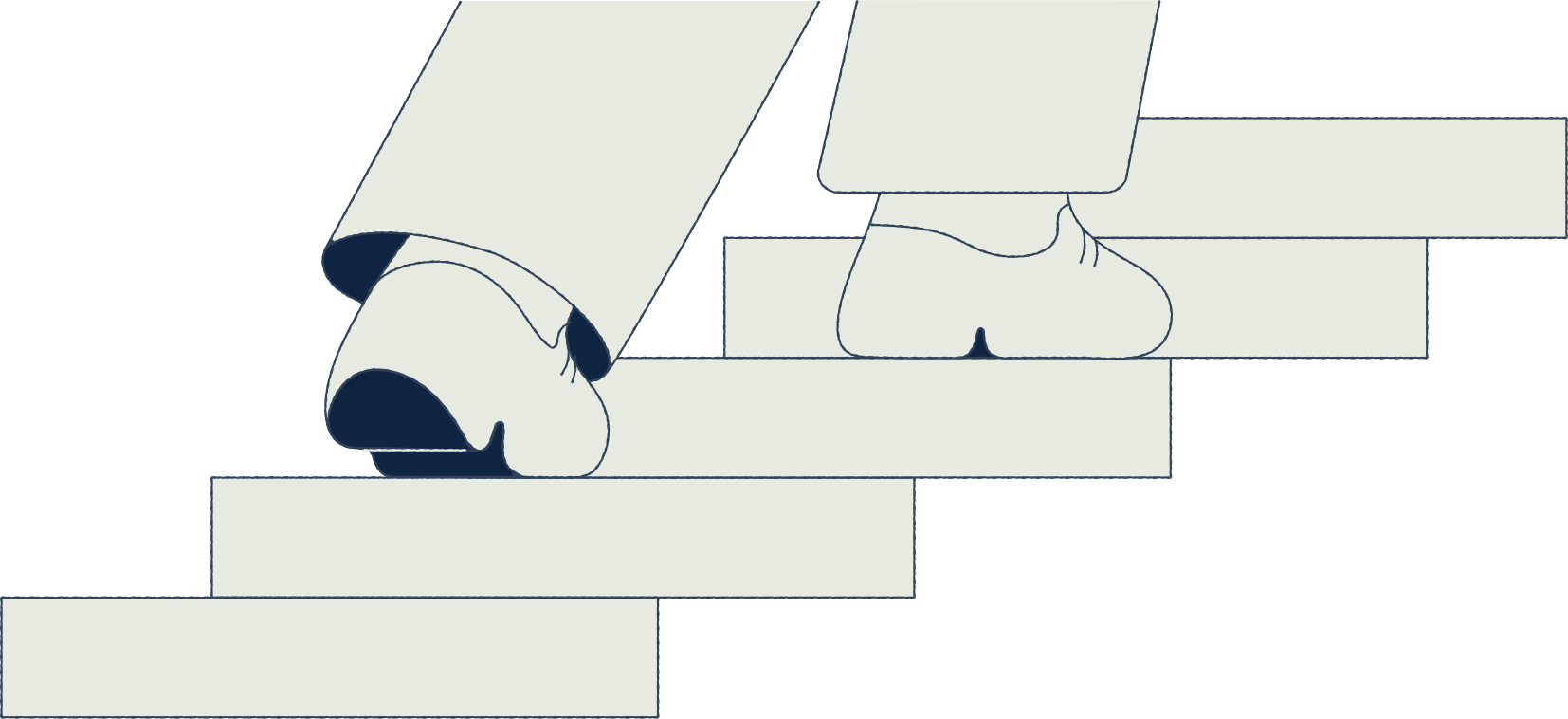
One session at a time. Clear next steps. More support if you want it.
How SST may help you
If you want clear, practical support without committing to open-ended therapy, Single Session Therapy offers one structured session centred on what matters most to you right now. Together, we agree what would make the session useful, focus on what is already helping (even slightly), and build realistic next steps you can apply in daily life.
Many people find this approach refreshing, especially those who have had therapy before and do not want to repeat long background histories. A single session may be enough for now, or it may be the first useful step before further work. You can decide, session by session, what support you need.
Sessions are usually held online, with in-person sessions arranged where possible. Appointments are slightly longer than a standard session in this service (up to 90 minutes), so there is enough time to get to the core issue, explore solutions, and build a practical plan.
A brief origin story
Single Session Therapy has a rich and practical history. The approach gained visibility through the work of Moshe Talmon, Michael F. Hoyt, and colleagues, who challenged the assumption that helpful therapy must always be long-term. Their core insight was simple but powerful: for many people, the first conversation can already be meaningful if it is focused, collaborative, and intentional.
From there, SST evolved in several directions: scheduled one-off sessions, walk-in formats, and one-at-a-time models where clients return only when they want further input. Over time, this work was developed by multiple international contributors. In the UK context, Windy Dryden has helped shape practical SST/OAAT frameworks that therapists can apply clearly and ethically. In Europe, Flavio Cannistra has expanded SST training and mindset-based practice, linking brief and strategic traditions with contemporary implementation, and contributing to the first portal devoted to Single Session Therapy. Other important contemporary contributors include Monte Bobele in the US, and Jessica Schleider with her Lab for Scalable Mental Health. In Australia, Jeff Young and Pam Rycroft leading the Bouverie Centre community have contributed to the one-at-a-time service perspective in family and community settings, showing how accessibility and quality can sit together.
This reflects that broader tradition. It is not a narrow model tied to one school or one person. It is a clinically grounded, evolving approach shaped by many practitioners, researchers, and services over time.
Me and Single Session Therapy
My story with Single Session Therapy began before I had the language for it. Early in my career, I worked with people experiencing homelessness and unstable housing, where engagement can be difficult and every contact matters. That experience shaped me. I learned to value focused, meaningful work from the first conversation.
As the years passed, I trained in different therapeutic models to better support the people I serve. Later, while working at Kooth, I re-encountered Single Session Therapy more explicitly through both practice and innovation work, including the development of therapeutic tools and outcomes-informed approaches. Through that journey, I became more connected to the SST community through research, training, and clinical practice.
What I found was a genuinely inspiring field: professionals committed to doing high-quality, ethical work in limited time, without losing depth, compassion, or rigour. It is a community that cares deeply about people, change, and transformation.
I am now actively involved in that international practitioner community and currently serve on the committee for the next symposium in 2027 (SST6.uk). Door to Therapy and Single Session Therapy are fully aligned: the model fits the core values of my service: accessibility, focus, collaboration, and meaningful outcomes.
There is a research side to this too. I led the development of the Session Wants and Needs Outcome Measure (SWAN-OM), an instrument built to measure what someone wants from a single session and whether they got it, and its validation in a web-based therapy service. A third study, which I co-authored, extended it to adolescents in 2026. In July of that year I presented The Digital Door at the BPS Division of Counselling Psychology conference, on holding onto this way of working from an independent practice.
Is SST right for me?
SST may be a good fit if you:
- ✓
Want Support With One Clearly Defined Issue
- ✓
Need Clarity Before An Important Decision
- ✓
Feel Stuck And Want Practical Movement
- ✓
Want To Try Therapy In A Focused Way First
People who often benefit include young adults seeking focused guidance, clients with previous therapy experience who want targeted work, motivated clients ready to try specific changes, parents seeking structured support, and people with common mental health difficulties such as anxiety concerns and some phobia presentations.
SST may be less suitable as a standalone option if you currently need intensive specialist, crisis, or emergency care. In these situations, you will be directed to appropriate services, or invited to complete a fuller clinical assessment for standard or specialist treatment.
What happens in a single session
- Agree the focus - what would make this session genuinely worthwhile.
- Clarify the pattern - what is happening, and what keeps it going.
- Identify resources - what already helps, strengths, exceptions, supports.
- Build a practical plan - one or two concrete steps to try.
- Decide what next - pause, book another one-off session, or continue differently.
You may receive a short optional pre-session questionnaire, inspired by Windy Dryden (2025), to help focus the work before the session starts. It usually explores the issue, why it matters now, what you have already tried, your resources and supports, and what kind of help you most want in the session.
Sessions often feel
- ✓
Focused and purposeful
- ✓
Collaborative and respectful
- ✓
Practical and action-oriented
- ✓
Transformative and empowering
- ✓
Grounded in your strengths and resources
- ✓
Structured, with clear takeaways
Further interesting reading
Common questions
- Is one session really enough?
- For many people, yes. A single session is built so that one focused conversation is useful on its own, with clear next steps you can act on. The evidence on single-session work is encouraging across difficulties like anxiety, low mood, grief and specific fears, but it is not right for everything. If your situation needs more, I will say so.
- What if I need more than one session?
- Then you book another when you want one. That is what one-at-a-time therapy means: each session stands on its own and you decide whether to come back. There is no package to commit to and no waiting list.
- How much does a one-off therapy session cost?
- A single session is £100 and lasts up to 60 minutes. The 15-minute consultation beforehand is free and carries no obligation.
- Is a single session the same as the free consultation?
- No. The free 15-minute consultation is a short call to check whether this is a good fit. A single session is the therapy itself: a full appointment with focused work and practical next steps.
- Can I book a single appointment online?
- Yes. Sessions run online across the UK and Spain, and in person in London and Madrid. You book directly and you do not need a referral from a GP.
- What is one-at-a-time therapy (OAAT)?
- The same idea under another name: therapy offered one session at a time, with the option to return. You may also see it called single session therapy, SST, or simply a one-off therapy session.
Related Therapeutic Approaches
About the author
This page is written and reviewed by Dr Santiago de Ossorno García, Counselling Psychologist, with a Doctorate in Psychology and over 15 years of practice. He is registered with the Health and Care Professions Council in the UK (PYL040507), Chartered with the British Psychological Society and registered with the Colegio Oficial de la Psicología de Madrid (M-25309), and has 27 published works and 134 citations recorded by OpenAlex. He works in English and Spanish, online across the UK and Spain and in person in London and Madrid, using single-session therapy, solution-focused brief therapy, CBT and EMDR. More about Dr Santiago
Ready to leave with a clear next step?
Book a Single Session directly if you want focused support now.
You can also start with a free 15-minute consultation if you prefer to check fit first.
 Book a Single Session
 Book Free Consultation