Cognitive Behavioural Therapy (CBT)
A brief origin story
CBT emerged from the work of psychiatrist Aaron T. Beck in the 1960s, who noticed that many people experiencing depression had streams of automatic negative thoughts about themselves, the world, and the future. At around the same time, psychologist Albert Ellis developed Rational Emotive Behaviour Therapy (REBT), showing how rigid "musts" and "shoulds" could create emotional suffering.
Together, their ideas helped shape modern CBT: the understanding that how we interpret events strongly affects how we feel and act, and that changing unhelpful thinking patterns can reduce distress and open up new choices.
Both were American, both started out as psychoanalysts and both left for different reasons. Ellis was a psychologist, took his doctorate at Columbia in 1947 and set up his own institute in New York. He gave up psychoanalysis in 1955, tired of a method he found slow and hard to test, and took to disputing head on the absolute demands he heard in the consulting room. Beck was a psychiatrist and spent nearly seventy years at the University of Pennsylvania. He did not set out to leave psychoanalysis but to prove it: he designed a study to confirm its account of depression, got the opposite result and followed the data. Rather than dispute anything he asked questions, treating each thought as a hypothesis you can go out and test.
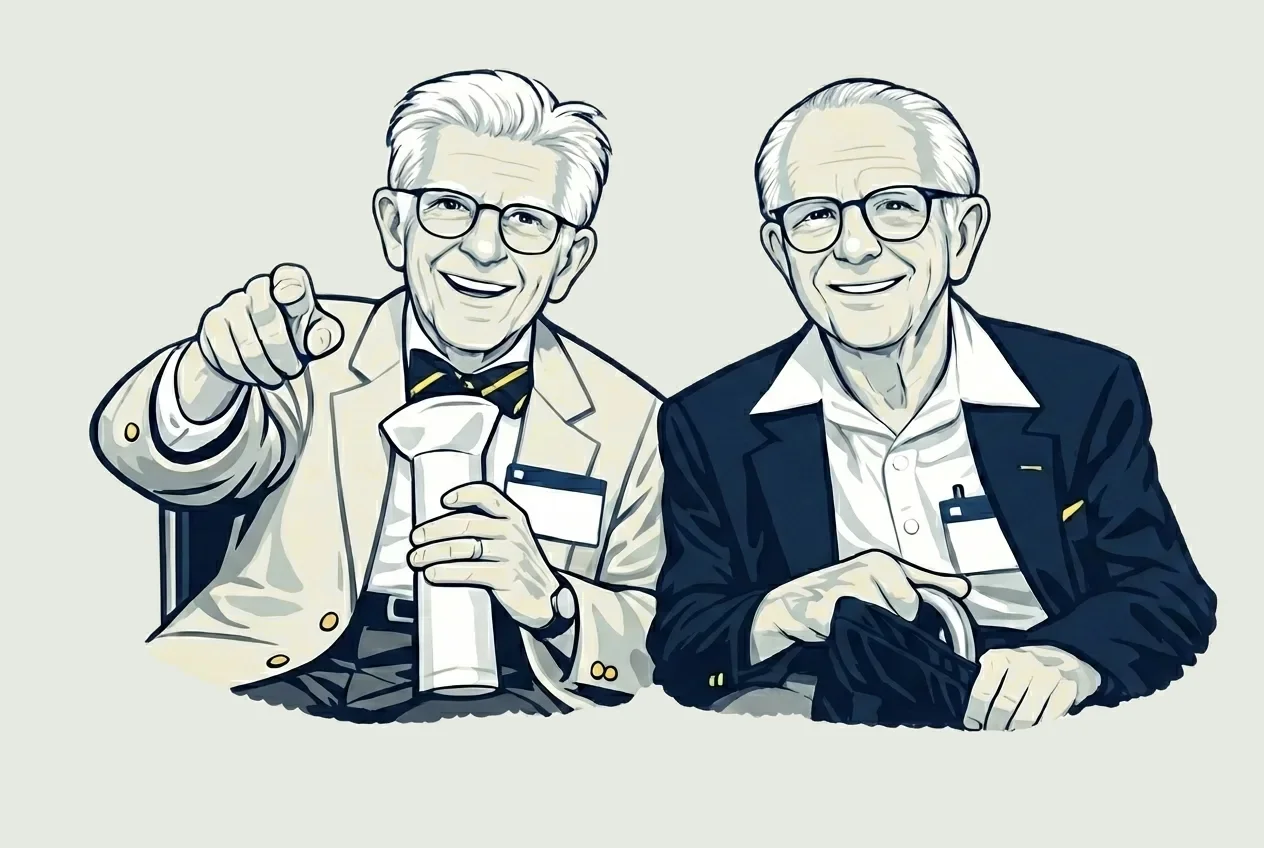
They met in 1963 by letter and stayed in touch for the rest of their lives, though they never quite came to agree. When they sat down to debate in public at the American Psychological Association convention in 2000, Beck was seventy-nine and Ellis eighty-seven. Even so the two were on the same side. What the hyphen joins is not them but that cognitive current and behaviour therapy. That one came out of research on learning and worked with what a person does, not what they think. The two schools came together in the seventies.
How CBT may help you
In CBT we gently map out the links between thoughts, feelings, bodily sensations, and behaviours, and look for patterns that may be keeping problems going. You are then supported to try new ways of responding: adjusting unhelpful thoughts, experimenting with different behaviours, and practising skills between sessions so that change becomes part of daily life.
CBT is widely used and well-evidenced for anxiety difficulties, depression, panic attacks, phobias, obsessive–compulsive patterns, stress, and sleep problems.
Sessions often feel
Structured and transparent
Practical and skills-based
Collaborative and goal-oriented
Grounded in everyday situations
What a session looks like
The first session is mostly about understanding what brings you here and what you would like to be different. After that, CBT sessions have a recognisable shape: we look at how the week went, agree what to focus on that day, work through a specific situation, and end with something to try before we meet again.
That “trying things between sessions” part is not homework handed down. It is where most of the change happens, because what makes sense in the room has to work in the place where the problem actually shows up.
Sessions last 50 minutes. If the plan stops making sense, say so and we change it. CBT is deliberately explicit, and you should be able to explain what we are working on and why.
How many sessions it usually takes
It depends on what you arrive with, and I would rather say that than give a number that sounds better than it is.
The CBT protocols tested in clinical trials usually run from 8 to 20 sessions for difficulties such as anxiety or depression. In private practice, working in a brief format, many people notice change sooner and stop once they have enough to carry on by themselves.
What I do is agree a first review at four or five sessions: what has changed, what has not, and whether it makes sense to continue. If it is not helping, it is better to know early.
What it works well for, and what I would not start with
CBT has substantial evidence behind it for anxiety, panic attacks, phobias, obsessive-compulsive patterns, low mood, stress and sleep difficulties. It is the most studied approach there is, which is a reasonable argument for starting there.
It is not the only option, and there are situations where I would start elsewhere:
- If what weighs most is a traumatic experience that is still live, I usually suggest EMDR work first.
- If you want to understand where something comes from rather than change a specific pattern, a person-centred approach fits better.
- If you arrive with one concrete decision and little time, solution-focused brief therapy or a single session tend to be more direct.
This is not a closed list, and you do not have to work it out before we start. We talk it through in the first consultation.
Where I work
In person in London and online across the UK. CBT works particularly well online because much of the work is structured and leans on worksheets and exercises that can be shared on screen.
I also work in Spanish, if that feels more natural to you.
— Aaron T. Beck
— Albert Ellis
Further interesting reading
Beck Institute – "The History of Cognitive Behavior Therapy"
Beck, A. T. – Cognitive Therapy and the Emotional Disorders
The Albert Ellis Institute - Rational Emotive Behavioural Therapy (REBT)
Hofmann et al. (2012) – Meta-analysis on CBT effectiveness
Video: "The Blueprint of CBT" (Beck Institute youtube channel)
CBT you can start on your own
The three programmes below use the same approach as the therapy on this page. They are complete, free, and need no sign-up or subscription. If you would rather do it with someone alongside you, that is what the sessions are for.
Spot automatic thoughts, test them against evidence, and build a more balanced view.
Recognise exhaustion and rebuild a sustainable pace, with CBT and stress-management tools.
Step out of the cycle with behavioural activation and cognitive work, step by step.
About the author
This page is written and reviewed by Dr Santiago de Ossorno García, Counselling Psychologist, with a Doctorate in Psychology and over 15 years of practice. He is registered with the Health and Care Professions Council in the UK (PYL040507), Chartered with the British Psychological Society and registered with the Colegio Oficial de la Psicología de Madrid (M-25309), and has 27 published works and 134 citations recorded by OpenAlex. He works in English and Spanish, online across the UK and Spain and in person in London and Madrid, using single-session therapy, solution-focused brief therapy, CBT and EMDR. More about Dr Santiago
Ready to Explore This Approach?
CBT might be right for you if you're looking for structured, practical support to understand and change unhelpful patterns.
Start with a free 15-minute consultation, no pressure, no obligation get to know how CBT can help you.
 Book Free Consultation